
Let’s say we have two countries, A and B. They start out at equal levels of wealth, with residents making on average $100,000 a year.
A chooses a more capitalist system, and B chooses social democracy. Let’s say that, because of this, a poor person in B is better off.
At the tenth percentile of income, assume a person in A makes 35% of the average, or $35,000 a year. In Country B, because it engages in more redistribution, the person at the tenth percentile makes 45% of the average income, so $45,000. This is unrealistically high for the difference between relatively unequal and relatively equal rich countries, as the gap between the US and Sweden is much smaller than this. But let’s just go with it.
Let’s also assume that because A is more capitalist, it has faster growth. A grows at 2% a year, compared to 1% a year for B. In per capita, PPP-adjusted terms, America has grown about an extra 1% a year compared to Italy over the last three decades, so this is not unrealistic.
Here’s what happens in each country to average income and income at the tenth percentile over the next fifty years, assuming the ratio between the two doesn’t change.
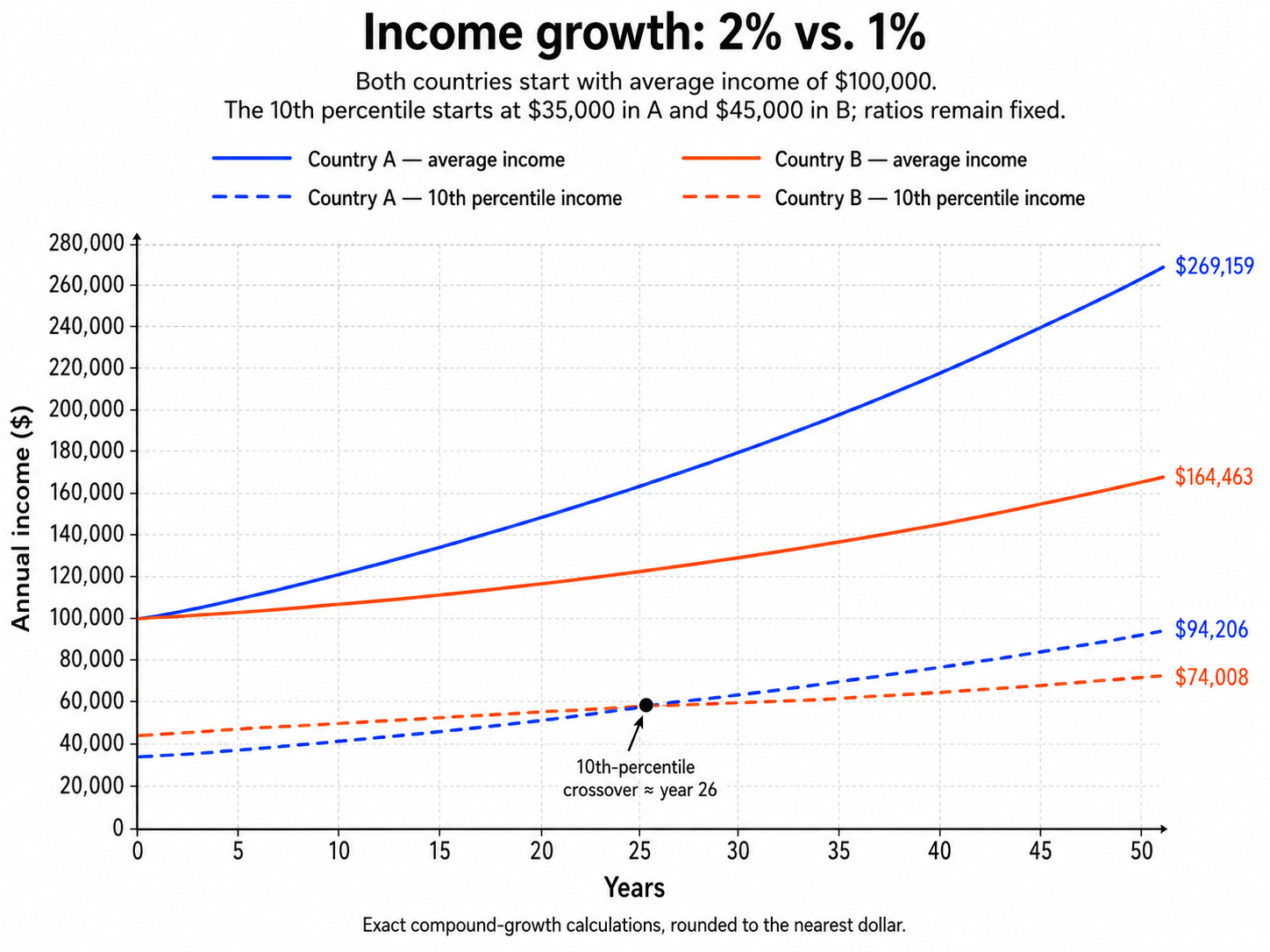
By year 26, the poor person in A ($58.6K) ends up wealthier than their counterpart in B ($58.3K). From there, the gap grows. In 50 years, the poor person in A is at $94K, compared to $74K in B. That’s ignoring what has happened to the average, which is now $269K in A and $164K in B, and of course we’re ignoring everyone doing better than average too.
Now assume that B’s embrace of social democracy isn’t that bad in terms of economic efficiency, and it grows at an annual rate of 1.5% instead of 1%. This is about the average annual difference of GDP per capita growth between the US and France or Germany over thirty years. What happens in that case? Take a look.
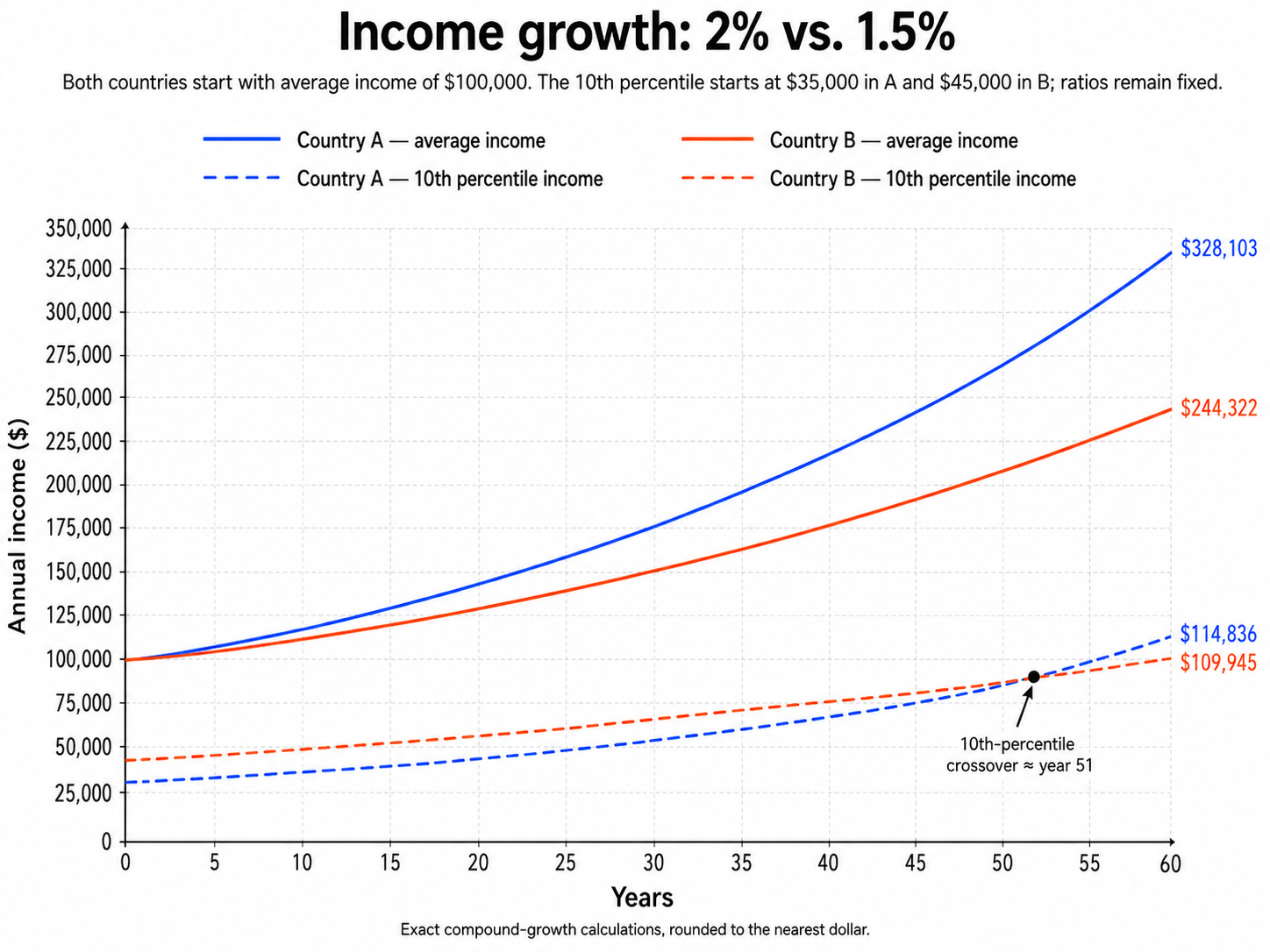
Now it takes about 51 years for the poor in A to catch up.
In each scenario, they end up better off. It all depends on how fast each nation grows and what exactly the poor-to-average ratio of income is. But the higher growth country wins in each case if you just wait long enough. We’re talking two generations at most. But people argue that we need to solve global warming, or the national debt, or whatever because of what these issues mean for our children and grandchildren. Even if you expect your descendants to be poor, by the time they’re adults you can look forward to them being better off in a less equal country as long as it has a slightly more dynamic economy. This is the miracle of compound growth.
We’ve run this experiment already, and seen the results. Comparing the tenth percentiles, Americans earn slightly more than Germans, Brits, and Swedes, despite European countries being more equal. Of course, the gap gets larger as you move up the income ladder.
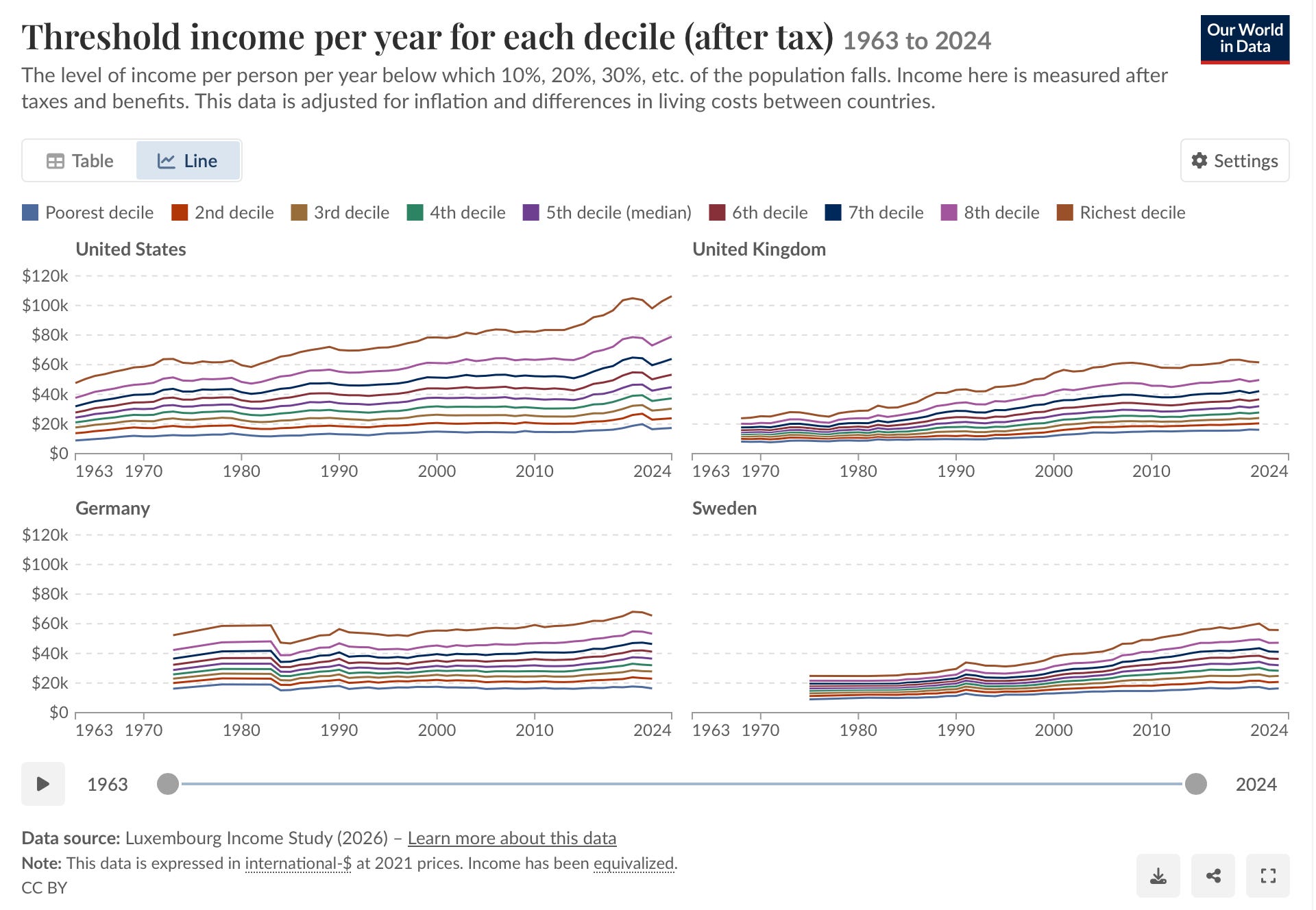
Interestingly, as recently as ten years ago the tenth percentile in Germany had higher incomes than in America. But we made our poor better off not by becoming more equal, but by growing faster.
None of this even requires you to care about the average citizen, or – God forbid! – people who are above average. But from a utilitarian perspective, you should care about everyone, not just those near the bottom.
Another consideration is that poorer countries often benefit disproportionately from growth and innovation in richer nations. States at the technological frontier generate new ideas and production methods that poorer ones can adopt, allowing them to grow partly through catch-up rather than having to invent everything themselves.
The US is the country most responsible for biomedical innovation in the world today, and at the cutting edge of the artificial intelligence revolution. People all over the world take drugs invented in America and rely on software developed in Silicon Valley in their businesses and personal lives. A country that is more innovative not only does better itself, but contributes to the well-being of other nations.
Of course, not every economic policy decision involves a tradeoff between dynamism and equality. NIMBYism, for example, makes us poorer and probably makes inequality worse too. That’s why we should stamp it out. And Sweden and Denmark have done better than the rest of Western Europe in terms of both income equality and overall growth in recent decades, likely in part due to their “flexicurity” model, which is superior to the rigid labor regimes that exist in France and Germany. If you really want to help the poor in the immediate future, you need to think long and hard about what kinds of leveling policies hinder growth, and which don’t.
I think that there’s generally a pretty direct tradeoff when it comes to redistribution. For a welfare state, you need to take money from certain people and give it to those who the government judges need it more. If you let individuals keep less of what they earn, whether through income, sales, or property taxes, they will work less. There is nothing mysterious about this. People talk positively about Europeans taking more vacations, which you will of course do if you are taxed more heavily. But when the choice is up to them, people, and high earners in particular, seem to like earning money. No advanced country bans vacations. Nations just do more or less to nudge you away from work and into taking them.
Generally, it is considered a good thing when people save today and plan for the future. With economics, it’s different, at least among those with left-wing political ideas. They celebrate more socialistic societies that indulge themselves today on the growth created in the past and denounce those who are working for the good of future generations.
Some people believe that equality is good for its own sake. I can’t say anything here except that this view is evil. What do we say about someone who is happy when his house is damaged in a tornado just because his neighbor ended up in an even worse situation? Every philosophy built on benevolence toward humanity would say that this reflects bad character. But for some reason, it is considered morally acceptable to adopt such an outlook as a basis for one’s economic and political views. Not sure what I can say about this other than it is bad, and those who think like this are bad people.
But others on the left genuinely care about the well-being of the poor, and for them the case for prioritizing growth over distributional concerns is quite strong.
This post is sponsored by Mechanize. They are hiring software engineers at a base salary of $300K-$400K/year, plus substantial bonuses. They also have openings for other positions, including Research Engineer ($500K base pay), Recruiter ($200K), Growth Manager ($250K), Interns ($150/hr), and legal counsel ($400K). You can even “build your own role.” Here is their website, and you can apply here. If you apply, make sure to use the links provided here so I can receive credit, and name me as a reference in the process.
I completely agree that prioritizing growth over equality is correct, but I don’t think redistribution is the most important contrast with Europe. In some ways the US tax system is more progressive in terms of distribution than Europe, which funds its more expansive welfare states with broad regressive taxes like the VAT, while the US is more reliant on progressive income taxes. It’s true that in some countries like France the top income tax bracket is so onerous that this discourages work but this is not universally true. In fact some countries in Europe even have flat income taxes !
The main drags on European growth (labor market regulations, precautionary principle type regulations on certain technologies) are not really related to redistribution and I think higher inequality in the US is largely exogenous to the tax system so I don’t think growth vs. redistribution is the most important trade off. I would say growth/dynamism/disruption vs safetyism/stability/stagnation is the more important difference.
Of course, but you're ignoring the envy and social disruption that can occur when inequality increases. It's not always about the money you have, it's where you sit in the distribution.